Showing posts with label west nile virus survivor. Show all posts

Saturday, August 24, 2019

CDC West Nile Virus Info


Thursday, July 24, 2008

Richard Gibson, CA survivor


West Nile virus victim feels the bite Published: July 01, 2008 1:00 PM

“I’m your one per cent,” says a man I’ve yet to formally meet.
Richard Gibson wheels his way through The Valley Echo and into the reporter’s office.
He’s speaking about a recent article we’ve published on the precautions a person should take to avoid the West Nile bite.

The Saskatchewan man has a firsthand account of the severity the disease can inflict.
On August 16, 2007 Gibson began to experience a barrage of sickness, which he was told was a sinus infection.
Suffering chronic headaches, extreme exhaustion, eye irritation and chills, he went to a local walk-in clinic, his diagnosis was echoed Monday morning by his family doctor.

But a few days later his illness had intensified so severely that the now delirious Gibson spent 11 days in intensive care. He had been admitted to Yorkton Hospital August 22.

After extensive blood work and a spinal tap, doctors were able to diagnose him with the West Nile virus. But with no means to cure the disease, time and an abundance of antibiotics were hoped to aid Gibson.

As cases are still relativity rare in Canada, medical personnel had little assurances to offer his family. They simply didn’t know what the outcome would be.
As a result of the virus Gibson had meningitis and paralysis, leaving Gibson without the use of his legs and arms.
After one month in hospital he was transferred to Regina’s Wascana Rehabilitation Centre where he spent five months regaining his ability to walk and make use of his arms.

When he managed to finally get home it was December. By then Gibson had lost his job as a minister. He and his wife had to move from the church’s manse.
Today Gibson is mobile with the aid of a walker. He’s regained most of his ability in his right arm; his left is still paralyzed from the elbow up. He continues to go to rehabilitation everyday.

“I’m far beyond what anyone thought possible, but I’m nowhere near where I was.”
Recently Gibson and his wife Kathleen organized a forum for other West Nile survivors.
At the Saskatchewan gathering the couple met many victims of the virus. All of them had endured different degrees of the illness.
Some in attendance had experienced moderate mild flu-like symptoms, others represented loved ones who had died from the virus.

Gibson says he has yet to encounter any two people who have had identical symptoms.
Trying to make sense of the disease, Kathleen is in the midst of writing a book on their personal ordeal. The Gibsons hope to bring to light just how detrimental West Nile can be and encouraged others to take precautionary measures against insect bites.

“Most people don’t recognize how serious it can be. Something that happened to me might happen to someone else.”
While West Nile virus has yet to be detected in B.C., scientists are waiting for the first case to be found. “There is no cure, only prevention."

Melissa Dimond, UT Survivor


Victim struggles with West Nile effects
Bountiful woman still battles virus' aftereffects
By Heather May The Salt Lake Tribune
Article Last Updated: 07/24/2008 12:37:07 AM MDT

BOUNTIFUL - As she stood outside her new home with her new husband two years ago, Melissa Dimond was bit by a mosquito. She remembers thinking, "I hope I don't get West Nile [virus]." Two weeks later came the telltale signs. She developed a rash and severe headaches. She lost some vision in her left eye.
The type 1 diabetic grew spacey, twice throwing away the device that checks her blood-sugar levels. Eventually, after a couple of emergency room visits because she couldn't keep food or water down, close one of her eyes or remember how to put contact lenses in or use her insulin pump, tests confirmed she had the virus and one of its most serious repercussions. The virus had developed into meningoencephalitis - it had inflamed her brain and the membranes of the spinal cord. Most people infected with West Nile don't develop symptoms.
Dimond and her husband, Blake, spoke to reporters Wednesday about her ordeal as a cautionary tale about the importance of protection during mosquito season. To make the point of how easy the virus is to contract, Dimond noted she knew something about the disease as an epidemiologist at the state health department. "This type of illness is really rare. That needs to stay in perspective," she said from her living room couch. But, she added, "it's really not worth the risk, even if it is small."
Common in Africa, West Asia and the Middle East, the virus spread to the United States in 1999 and to Utah in 2003. It's typically spread through mosquitos, which become infected after feeding on infected birds. Last year, the state reported 70 human cases that resulted in two deaths. So far this year, the virus has infected two people, one in Uintah County and another reported in Salt Lake County this week. Both reported fevers. The virus has also been detected in either pools, mosquitos or birds in Box Elder, Davis, Kane, Millard, Utah and Washington counties.
The state health department says the virus has surely spread throughout the state. Dimond guesses she was outside at dusk for about 20 minutes when she got bit in September 2006. She thinks she was so severely affected because her immune system was compromised by diabetes and a sinus infection she had at the time. She spent about a month in the hospital. She couldn't swallow, smile or stick out her tongue. She couldn't walk or raise her arms and she had double vision. Doctors didn't know if she suffered brain damage. "It was devastating," Blake Dimond recalled. "To see your wife without any facial expression, sick, relying on machines to feed her. . . . I just wanted to know: Is it going to be my same Melissa that I married?"
It took six months of relearning skills as basic as coughing and spitting to get to where she is today. She still tires easily and has trouble walking because the toes of her left foot curl in. But she is back to work and can take care of herself again. Her vocal range has limits, but she has rejoined her church choir. Her goal is to be able to mountain bike again. The couple are more cautious than ever about warding off mosquitos. Citronella candles are on the porch. She steers clear of most evening barbecues. "I'm really proud to have her back," Blake Dimond said. "I had no idea she could get that sick."
contact: hmay@sltrib.com

Thursday, July 03, 2008

Stacie King, MS

Pontotoc mother wins battle with WEST NILE VIRUS

Align LeftStacie and Savannah


(Stacie King spraying her 5-year-old daughter Savannah.)

By SANDRA PRIEST
Special to the Progress

It�s hard to believe that a tiny insect could cause a grown woman so much trouble, but for Stacie King just one pesky little mosquito almost cost her her life.
It all began early on a September morning when Stacie woke up with the worst headache and backache she had ever experienced. �I wasn�t able to go to church that day,� she says as she remembers the unexpected turn of events last fall. Her symptoms soon included dizziness, nausea, and weakness. �Everyday I just got worse,� she recalls with a faraway look in her eyes.
When her unusual symptoms didn�t improve she finally decided it was time to see a doctor. Stacie�s husband Derrick says, �Now, if I start to get a sniffle I run to the doctor, but Stacie never goes.� He knew his wife was really sick�and worried.
She made an appointment with Dr. Joseph Montgomery. Because Stacie�s symptoms were uncommon, and the routine tests in the office didn�t give any real clues to help in making a diagnosis, Dr. Joseph consulted with his older brother Dr. Steve Montgomery. Dr. Steve was puzzled as well by the mysterious symptoms that by now included a high fever. Trying to get to the root cause of the strange illness they decided to order a CT scan, as well as blood tests for a long list of diseases�a lot of which were fatal. �It�s a scary feeling when the doctor puts you in the hospital and doesn�t know what is wrong with you,� Stacie vividly remembers.
After the CT scan came back normal a spinal tap was ordered to check for meningitis, an inflammation of the membrane around the brain and spinal cord. This test came back positive. One piece of the puzzling illness had fallen into place, but Dr. Steve, who was the one on call that weekend, didn�t think that was the whole puzzle. Stacie explains, �He was anxious to see what the blood work that had been sent off to the Mayo Clinic in Minnesota showed.�

Puzzle solved
After the results from the Mayo Clinic came in, the puzzle of the mysterious illness was finally solved. Derrick remembers how scared he and Stacie were when they first heard the diagnosis. �When he (Dr. Steve) walked into the room and said �Well, I know now what you�ve had�, we just held our breath. When he said it was West Nile Meningitis I thought that was a death sentence, but he said �But you�re going to be fine�.�
Dr. Steve explained that the disease is extremely rare and that it would take quite some time for Stacie to fully recover. In all his years of practicing medicine, this was his first patient with West Nile Virus. �He said he was just as shocked as we were,� Stacie recalls. Her case was the first and only instance of West Nile Virus reported in Pontotoc County in 2007.
As a mother of five, Stacie can�t imagine a child going through an ordeal like hers. �I think parents should be real cautious and should be real aware. You think it would never happen to you.�
The King family is thankful that Stacie is on the road to recovery. Although she still tires easily she is doing well. Stacie and Derrick are especially thankful for family and friends who helped them through those difficult weeks while she was in the hospital and recuperating afterwards. �If it had not been for family and friends we would have been in a tight�a real tight,� Derrick says gratefully. Stacie adds with a smile, �The good Lord works it all out. He always has for us.�

Appeared originally in the Pontotoc Progress, 7/1/2008, section C , page 1

Tuesday, May 06, 2008

Mel Lacy, ID


Man paralyzed by West Nile shares harrowing tale
05/02/2008 11:39 AM MDT


Mel Lacy on his long road to recovery
BOISE - Summertime will soon be here and so will those blood-sucking mosquitoes. Since West Nile virus first appeared in Idaho – thousands of people have been infected.

One of those people – Mel Lacy, shared his struggle with the potentially debilitating virus.

Doctors diagnosed Lacy with West Nile on his wedding anniversary in August of 2006.
Later that month he was admitted to the hospital because he couldn't stop throwing up.

Two months later he woke up paralyzed from the neck down.
“It feels weird I feel like I am falling forward,” Lacy said.
Lacy fights everyday to overcome the affects of West Nile - working to gain muscle in his arms and legs.
“When he first came in he had the tracheotomy he was in a wheel chair pretty much totally dependant for all his mobility,” said physical therapist Jill Harris, St. Luke’s Idaho Elks Rehabilitation Services.

Lacy hasn't been able to walk on his own since 2006.
That summer this 51-year-old handyman, who loved to build cabinets, fell asleep one night and woke up with a mosquito bite and West Nile.
A couple months after his diagnosis, Lacy realized how serious the virus could be.
Idaho West Nile cases
  • 2003: First human case
  • 2004: Three cases
  • 2005: 13 cases
  • 2006: 1,000+ cases
  • 2007: 132 cases
  • 24 Idahoans have died from West Nile virus

“I couldn't move anything but my head,” he said.
It was a period of time that changed Lacy’s life and his family's forever.
“He was real ‘do it all and do it yourself’ and always did everything for us and to have to do everything for him is odd,” Lacy’s daughter Melissa Olson said.
Through therapy, Lacy has regained some of his independence and now has more mobility on the top half of his body.

He is breathing on his own and using his hands to accomplish everyday tasks.
“I have no lift to my arms this way so if I need to eat I have to pivot this arm to get my arm up or to shave,” Lacy said.

For Lacy, the fight after the bite is one of the toughest battles of his life.
“I had cancer at age 34 that they said I wouldn't live through (it), and I thought I had done my hard part in life and I passed those odds and then when I got this I thought well, there's really a challenge,” he said.

It is a struggle physically and emotionally.
“They do have antidepressants that help,” he said. “But I really believe its my faith that gets me by where I am.”

Lacy hopes by telling his story he can save others from getting the West Nile virus. His daughter says her dad’s experience has changed her habits.
“I make sure I douse with DEET and wear long sleeves,” Olson said. “It’s worth it because I don't want to end up in a chair like my dad.”

A chair Lacy is working to get out of.
“He gives 100 percent he does what he can to get better and I know someday he will meet his goals because he is determined,” Harris said.
“The dream is still there,” Lacy said. “Now I am just concentrating on trying to get better.”

Lacy says insurance companies estimate his health care costs have exceeded $750,000 and that does not include his prescriptions.

Because of West Nile, Lacy has been dropped by all insurance companies so now he has to cover the costs on his own.

He hopes to be eligible for Medicare later this year so he can afford to get back to physical therapy on a routine basis.

Tuesday, November 06, 2007

James William Cook Sr. , OK-Victim

Faces of West Nile: Even the 'strongest man in the world' wasn't safe from virus
James William Cook Sr.


By Ron Jackson, Staff Writer--CUSHING

James William Cook Sr. was the undisputed "strongest man in the world” to his children. A man who once fought his way out of a coma following a major car wreck.

So when Cook died from a mosquito bite Sept. 28 — becoming one of seven Oklahomans to die from the West Nile virus this year — his loved ones were shocked.

"A mosquito,” said Jim Cook Jr., 49, of Agra in disbelief. "It's still hard to believe that's what killed my dad. To me, he was the strongest man in the world.

"If he could die like that, any of us could.”

Cook Sr., 81, of Cushing and his family discovered the randomness of the deadly West Nile virus, which experts say is most harmful when it preys on youngest and oldest among us. For the Cook family, the West Nile virus is no longer just a disease heard on the news.

It's personal. "My father's doctor told us he used to go home each evening and sit out on his porch,” said Betty Cook, 50, of Coyle and the eldest of six Cook children. "After watching what this disease did to my father, he said he wouldn't do that anymore.”

The end was slow and agonizing for the elder Cook.

Dizziness suddenly plagued him. He felt like he was in a fog. He became nauseous and weak.

"We first took him to the hospital here in Cushing, but they failed to diagnose what was wrong,” said daughter Terrie Ostmeyer, 45, of Cushing. "For a while, we thought maybe he needed new glasses. I took him to the eye doctor twice.”

But the dizziness continued.

Putting family first

Only a year earlier James Cook was doing what he loved to do — work.

Over the years he was a truck driver, a traveling evangelist and a butcher. He was never idle. Even in his final years, he sought employment, working at Wal-Mart for a time and even a local car wash.

Before his death, he even boldly applied for work at the Cimarron Correctional Facility — a prison in Cushing. He wanted to be a correctional officer.

"They told him he was too old,” Betty Cook said with a laugh. "He was upset. He said, ‘Can they do that?' ”

James Cook prided himself on being a strong man.

Grandchildren often hung on his outstretched arms for fun. Years earlier, Jim Cook witnessed his father balance two 75-pound boxes of beef in the palms of his outstretched hands to the amusement and wonderment of his younger co-workers.

Family meant everything to him. He treated his wife, children and grandchildren to wiener roasts, picnics, camping trips, and vacations to places such as Colorado and California.

And he sacrificed for them.

"I remember one time when I was in fifth-grade,” Betty Cook recalled. "I walked through the front door, and I saw Dad sitting in his chair with his legs extended. The soles of his shoes had been worn through, and he must have cut some cardboard from a meat box to use as a cushion on the cement floor.

"I thought, ‘Gee, Dad needs new shoes.”

Betty choked back the tears.

"Then I looked down at my shoes,” she continued. "I was wearing new black and white oxfords.”

‘Tell everyone we know'

Four years ago at the age of 77, Cook suffered severe head trauma in a car accident. He spent 49 days in the hospital, 10 of which were spent in a coma.

He made a full recovery, and took advantage of his second chance.

Morning coffee was almost always followed by a trip to the front porch, where he'd ease into the worn pads of his metal swing and listen to the wind chimes.

Summer nights also beckoned him to his front porch swing — the spot where his family thinks he was ultimately infected by a mosquito bite.

"He loved to sit outside,” said Wilma Cook, his wife of 50 years. "A lot of times I'd find him on the swing asleep.”

Then one August day Cook became overwhelmed by a dizziness he called, "the blind staggers.” The ailment made no sense to those most intimate with his life.

Finally, on Sept. 8, his family admitted him into the VA Medical Center in Oklahoma City. Doctors diagnosed him with the West Nile virus eight days later. Within two weeks, Cook was dead.

"The doctor told us to tell everyone we know about the West Nile virus,” Terrie Ostmeyer said. "Tell our family, our friends, people at our church ... everyone.”

No one needs to tell her 9-year-old daughter, though.

Alexa Ostmeyer visited her grandfather's bedside before his death. As usual, he mustered enough strength to playfully stick his tongue out at his granddaughter.

She smiled despite the sorrow.

"He struggled really hard, but he said, ‘I love you,' ” Alexa recalled. "Then he squeezed my hand real tight.”
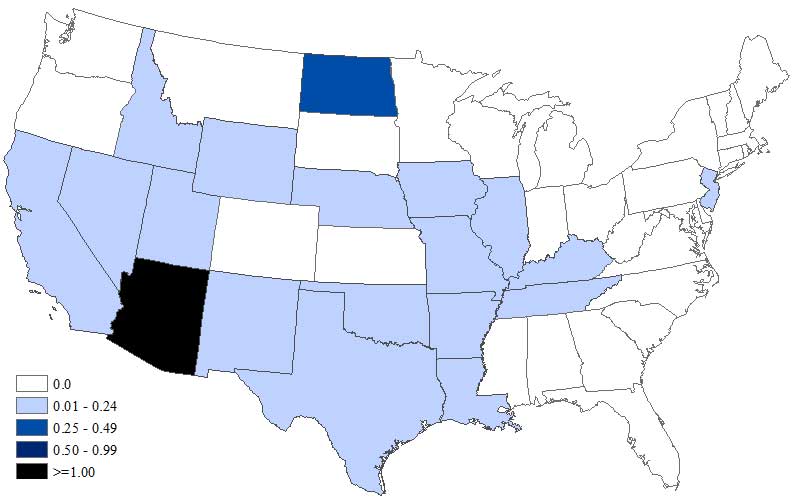
CDC West Nile Virus Info

Skip directly to page options Skip directly to A-Z link West Nile Virus Neuroinvasive Disease Incidence by State 2019 West Nil...