Saturday, November 19, 2005

Tom Steiner, WS


Tosa man battling West Nile dies
Steiner was principal of Wauwatosa West High School
By KAWANZA NEWSON
knewson@journalsentinel.com
Posted: Nov. 18, 2005

The principal of Wauwatosa West High School, who was diagnosed with West Nile virus, died Friday - the first such death in Milwaukee County since the disease was first detected in the state in the summer of 2001.
61763Steiner


Wauwatosa West High School principal Tom Steiner died Friday
VIDEO Coverage
Video: TMJ4 newscast (10 p.m.)

Tom Steiner, 55, was hospitalized about three weeks ago at Froedtert Memorial Lutheran Hospital in Wauwatosa, where he remained in critical condition until his death.

Steiner's family and physicians released little information.

"It's such a shock right now," said Lois Weber, president of the Wauwatosa School Board. "People will need to just digest that it's real, because we kept thinking he would get well."

Weber said she learned of the death about 4 p.m., a time when the majority of students had left the school for home. School officials announced Steiner's death at a basketball game Friday night.

Weber said Steiner, of Wauwatosa, is survived by his wife, Cathryn, a son and a daughter, and will be missed by many others as well.

"He was really a good listener (and) he was really well-respected, by not only his students but his staff and the parents," she said. "This is a sad loss for the school and the community."

West Nile is primarily a bird disease that spreads to humans when a mosquito bites an infected bird, becomes infected itself and then bites people.

Most people get no symptoms or only mild, flu-like symptoms from West Nile. But a small percentage develop encephalitis or meningitis - inflammation around the brain or of the spinal cord - and about 10% of those people die.

As with most infectious diseases, the elderly and people with health problems are more likely to die from West Nile than younger or otherwise healthy people.

Wauwatosa schools Superintendent Phil Ertl confirmed the diagnosis of West Nile to a reporter late Monday.
Detected in state in 2001

The West Nile virus first appeared in the United States in 1999 and was first detected in Wisconsin in dead birds in late summer of 2001.

As of Tuesday, 2,676 human cases - 16 in Wisconsin - and 91 deaths from West Nile virus had been reported to the U.S. Centers for Disease Control and Prevention in Atlanta this year. Most cases have been in California.

Wisconsin reported 16 cases and one death to the agency this year.

Last year, there were 2,470 human cases and 88 deaths in the U.S.

Raquel Filmanowicz, spokeswoman for the Milwaukee Health Department, said that Milwaukee County has confirmed eight West Nile cases this year, with four of those occurring in the city. The county reported no cases in 2004 and 2003.

Paul Biedrzycki, the Milwaukee Health Department's manager of disease control and prevention, said that 16 mosquito traps tested positive for West Nile this year, compared with only two last year.
Spring weather

The increase was likely the result of this year's very dry spring, he said.

The department has about 20 mosquito traps throughout the city that are tested each week for the virus, he said.

Biedrzycki is not surprised by the rise in human cases.

"Any time you have lots of infected mosquitoes, you're bound to see increases in human cases," he said.

From the Nov. 19, 2005, editions of the Milwaukee Journal Sentinel
Have an opinion on this story? Write a letter to the editor or start an online forum.

Sunday, November 13, 2005

John C. Wood, MD

CITY'S FIRST VICTIM OF WEST NILE DIES:
VIRUS SEEN AS ROOT CAUSE OF DEATH OF WEST-SIDE MAN STRIKEN 9 MONTHS AGO
By Jonathan Bor and Frank D. Roylance, Sun Staff

Days after John C. Wood was taken to Sinai Hospital in a coma last
August and declared the city's first victim of West Nile virus, his
family assumed that he would also be a survivor.

Wood, a retired steel worker and amateur handyman who loved to sit on
his porch near Druid Hill Park and chat with neighbors, regained
consciousness and was discharged to a nursing home, where he charmed
the staff with his winning smile.

But Wood was never well enough to come home. The virus left him
brain-damaged, unable to speak in full sentences or swallow properly.
Much of the time, his breathing was so labored that he was hooked to
a mechanical ventilator.

Last Saturday, just two days after his sister visited him at the
Levindale nursing home and left reassured that he was looking well,
Wood developed a lung infection and died. He was 73.

Though the immediate cause of death was pneumonia, doctors are
confident that the root cause was West Nile virus, which had made him
prone to inhaling fluids into his lungs.

"It came as a shock to me," said his sister, Jean Williams of Jessup.
"He seemed to be more alert."

Dr. Peter L. Beilenson, the city's health commissioner, said
yesterday that Wood's death does not cause him to reassess what he
said last summer when the mosquito-borne illness sickened two city
residents and four other people in Maryland.

The illness, he said, is rare and most often strikes elderly people
with underlying conditions that hinder their ability to fight off
infection.

Wood had been stricken with cancer. And though he was in good health
when he was bitten by a mosquito in August, the cancer had impaired
his immune system and left him vulnerable.

"Clearly, we feel for the family," said Beilenson. "But this case
points out what we've been saying: Human consequences of West Nile
virus are uncommon."

The first U.S. cases occurred in 1999, when 62 people within a
75-mile radius of New York City were hospitalized with infections of
the central nervous system. Seven of the victims died.

Though a dead crow that carried the virus was identified in Maryland
that year, the first human cases here were not diagnosed until last
year. Of the six people who became ill, three -- including Wood --
eventually died.

A 70-year-old woman from the city's Jonestown neighborhood who died
in September succumbed to an underlying illness, but Beilenson said
yesterday that West Nile was clearly a contributing factor. The death
of a 63-year-old woman from East Point was attributed to causes
unrelated to West Nile.

Cy Lesser, chief of the state's Mosquito Control Section, said
yesterday that it is "quite likely" that Maryland will see more human
cases of West Nile this year.

But the season is off to a slow start. No infected birds, mosquitoes
or horses have turned up this spring, despite their discovery in 10
other Eastern states, including Virginia, and in the District of
Columbia.

Though there has been enough rain this spring to fill the mosquitoes'
breeding pools, Lesser said that recent cool weather has probably
slowed replication of the virus inside the mosquitoes and temporarily
reduced their ability to infect birds.

Though they can't be sure, Wood's family says he could have been
bitten while sitting on his porch on Gwynns Falls Parkway.

"He was a darn nice guy," said his brother, Leroy Wood of Baltimore.
"He loved to talk to everybody who went by."

Neighbors became concerned in August when they noticed that he hadn't
shown up on his porch for about three days. When a nephew dropped by
to see if anything was wrong, he found Wood lying unconscious on his
apartment floor.

Dr. Debra Wertheimer, his doctor at the Levindale Hebrew Geriatric
Center & Hospital, said it was difficult for the staff to get to know
Wood because the brain infection had left him unable to speak in more
than simple phrases.

Wood's funeral will be held at 10:30 a.m. Monday at the James A.
Morton & Sons Funeral Home, 1701 Laurens St.

Copyright (c) 2002, The Baltimore Sun

Reyna Rodriguez, CA

Girl Who Contracted West Nile Virus Remains Hospitalized
Girl Cannot Walk Or Talk

POSTED: 6:07 pm PST November 11, 2005
UPDATED: 6:22 pm PST November 11, 2005

LONG BEACH, Calif. -- A 13-year-old girl who fell into a coma from West Nile virus remains hospitalized, unable to walk or talk, but her mother is hopeful she will get better.

Reyna Rodriguez was bitten by a mosquito in late August, but did not know she had the disease. Two weeks later, the Wilmington resident was admitted to a hospital with a high fever and rash.

Rodriguez became comatose as a result of a brain infection caused by the virus. She is now awake, but requires 24-hour care.

Maria Gonzalez, Rodriguez's mother, said her daughter communicates through slight movement of her fingers.

Health officials said most people do not get nearly as sick from West Nile virus, which is carried by mosquitoes that infect humans through their bite. There have been 41 reported human cases of West Nile virus in Los Angeles County this year and no deaths, although statewide, at least two people have died from the disease.

About 20 percent of infected people develop a mild illness, while 80 percent have no symptoms and recover on their own, county health officials said. Symptoms generally last three to six days and may include headache, rash, vomiting, nausea or eye pain.

Victims might develop paralysis, headaches, convulsions or fall into a coma.

Sarah Salmon, MS

West Nile strikes Sanguinetti after hurricane
By DAVID PHELPS
The nAtchez Democrat

Natchez — Natchez resident Frances Trosclair remembers her brother James Sanguinetti’s activities surrounding Hurricane Katrina well.

Temporarily forced away from his house on the north shore of Lake Pontchartrain, Sanguinetti was one of the lucky ones.

His house had only moderate damage. So he went to work helping neighbors get cleaned up.

That’s until flu-like symptoms set in. Originally diagnosed as a virus, Sanguinetti, 73, wasn’t admitted to the hospital until several days after his first doctor visit.

When Trosclair first visited her brother, on the Sept. 19, he was having trouble speaking. She remembers her sister-in-law asking if he knew who his sister was. He pointed to Trosclair and said, “Flossie,” a name she’d not heard before.

He was moved into intensive care shortly thereafter with a suspected stroke.

The Times-Picayune reported on Oct. 19 that Sanguinetti was one of two reported cases of West Nile virus in the wake of the hurricane.

After three weeks, two strokes and a tracheotomy, Sanguinetti has been transferred to a rehabilitation hospital in Covington. He is paralyzed on the right side of his body and beginning the recovery process.

While Sanguinetti shows symptoms of a stroke — which could have been brought on by the virus’ weakening his immune system — Natchez resident Sarah Salmon had completely different symptoms from her bout with the virus.

Salmon, 65, was infected in Natchez in September 2002. Though she got over her 102-degree fever and was back at work within a week, symptoms including a swollen left foot and tingling of her nerve ends on her left side sent her to the doctor.

“It affected my blood pressure, sent it sky high,” she said. “It took a year to get it back down.”

She still has periods where the nerves on the left side of her head tingle, but she considers herself lucky nonetheless.

She credited a support group for helping her deal with an illness nobody really understands.

“People who have had it talk to each other about their symptoms, it makes you feel better,” she said.

“You could talk to other people (outside of the group), but they had no idea what you were talking about.”

Salmon said she wanted to help spread the word about the virus in hopes that education will lead to prevention.

The Sanguinettis said they are doing a good job of letting family and friends know what James is going through.

E-mail updates written by his son, Jay, and Jay’s wife, Lucy, keep loved ones posted on the steady, if slow, progress.

The younger Sanguinettis, of Hattiesburg, and Trosclair are among the family members who travel regularly to Covington to visit James and Claudette.

They’ll make a special trip this weekend to wish Sanguinetti a happy birthday. Jay Sanguinetti has gathered nearly 100 cards — including a “who the heck is Flossie?” card from Trosclair — e-mails and letters which he is having bound to give his father as a present.

“The outpouring of support has been incredible,” his wife Claudette Sanguinetti said. “I couldn’t have made it without it.”

James Sanguinetti, MS

West Nile strikes Sanguinetti after hurricane
By DAVID PHELPS
The nAtchez Democrat

Natchez — Natchez resident Frances Trosclair remembers her brother James Sanguinetti’s activities surrounding Hurricane Katrina well.

Temporarily forced away from his house on the north shore of Lake Pontchartrain, Sanguinetti was one of the lucky ones.

His house had only moderate damage. So he went to work helping neighbors get cleaned up.

That’s until flu-like symptoms set in. Originally diagnosed as a virus, Sanguinetti, 73, wasn’t admitted to the hospital until several days after his first doctor visit.

When Trosclair first visited her brother, on the Sept. 19, he was having trouble speaking. She remembers her sister-in-law asking if he knew who his sister was. He pointed to Trosclair and said, “Flossie,” a name she’d not heard before.

He was moved into intensive care shortly thereafter with a suspected stroke.

The Times-Picayune reported on Oct. 19 that Sanguinetti was one of two reported cases of West Nile virus in the wake of the hurricane.

After three weeks, two strokes and a tracheotomy, Sanguinetti has been transferred to a rehabilitation hospital in Covington. He is paralyzed on the right side of his body and beginning the recovery process.

While Sanguinetti shows symptoms of a stroke — which could have been brought on by the virus’ weakening his immune system — Natchez resident Sarah Salmon had completely different symptoms from her bout with the virus.

Salmon, 65, was infected in Natchez in September 2002. Though she got over her 102-degree fever and was back at work within a week, symptoms including a swollen left foot and tingling of her nerve ends on her left side sent her to the doctor.

“It affected my blood pressure, sent it sky high,” she said. “It took a year to get it back down.”

She still has periods where the nerves on the left side of her head tingle, but she considers herself lucky nonetheless.

She credited a support group for helping her deal with an illness nobody really understands.

“People who have had it talk to each other about their symptoms, it makes you feel better,” she said.

“You could talk to other people (outside of the group), but they had no idea what you were talking about.”

Salmon said she wanted to help spread the word about the virus in hopes that education will lead to prevention.

The Sanguinettis said they are doing a good job of letting family and friends know what James is going through.

E-mail updates written by his son, Jay, and Jay’s wife, Lucy, keep loved ones posted on the steady, if slow, progress.

The younger Sanguinettis, of Hattiesburg, and Trosclair are among the family members who travel regularly to Covington to visit James and Claudette.

They’ll make a special trip this weekend to wish Sanguinetti a happy birthday. Jay Sanguinetti has gathered nearly 100 cards — including a “who the heck is Flossie?” card from Trosclair — e-mails and letters which he is having bound to give his father as a present.

“The outpouring of support has been incredible,” his wife Claudette Sanguinetti said. “I couldn’t have made it without it.”

Saturday, November 05, 2005

Kristy Chapman , CA

Student diagnosed with West Nile Virus
By: Adrienne Moore

A Cal Poly student could be the first human case of the West Nile Virus in San Luis Obispo County this year.

24-year old Kristy Chapman believes she was infected with the potentially serious illness while running on the track at Cal Poly in early October. She says her body was covered in mosquito bites and she developed flu-like symptoms.

"Around seven, that's when they're out here the most, so they're out here like crazy," says Chapman.

After being misdiagnosed at the Campus Health Center and Sierra Vista Hospital, Chapman consulted her hometown doctor in Sacramento.

"They thought it was strep throat, but when I talked to the doctors in Sacramento, they said the symptoms of strep throat and the symptoms of West Nile are pretty similar-- swollen lymphnodes," says Chapman.

The health department says they're unsure why thy appropriate information was not shared by the doctor, but are hoping to resolve the matter as soon as possible. Chapman's case would be the first human one on record with the county this year. For now, she says she will continue to wear bug spray every day, and now opts for a treadmill instead of the track for her treadmill.

"We've been going to the gym because I won't go outside, now I'm deathly afraid of mosquitos, I hate them," says Chapman. "So I don't like being outside."

Kristy Chapman says she feels fine today, and is looking forward to graduating next year. In 2004, one human case of the West Nile Virus was reported in San Luis Obispo County.

Ted Upgren, ND

West Nile Survivor: How I Almost Died from a Little Mosquito Bite

Ted Upgren's love of fishing may have cost him his life. Months after contracting West Nile virus from a mosquito, the author still suffers from the illness. Wildlife biologists muck around in the field so often and put up with biting insects like mosquitoes so routinely we may think we're immune to everything. I think differently today.

I was rapped hard by the West Nile virus, and while owning the distinction of being the first human West Nile case diagnosed in North Dakota in 2003, I had little else to crow about as this dreaded disease took me for a ride that almost ended my life.

I was a reasonably healthy 60-year-old in July 2003, but on the morning of the 17th I awoke in my camper at Lake Sakakawea State Park in another world. Weak, feverish and overcome by flu-like symptoms, I was in no shape to join my son Michael for the final day of pre-fishing for North Dakota's Governors Cup Walleye Tournament.

I stayed behind and Mike returned to check on me around 1 p.m. I was delirious, feverish and suffering a strange, fatiguing weakness in my right arm. My wife Kaye arrived around 3 p.m. to cart me home. Doctors diagnosed a flu condition. At home throughout the next day I continued to deteriorate.

Doctors Suspected Stroke

The next morning, Kaye had had enough when, sitting in my recliner chair, I was unable to lift or lower the recliner lever. At the emergency room, doctors ran blood tests -- the virus did not show in the blood. They did x-rays and a CAT scan, suspecting a stroke.

By evening, they decided to airlift me to Rochester. Kaye and two nurses accompanied my gurney, secured in a twin Cessna, to St. Mary's Hospital. From 1:30 a.m. until nearly noon, I was tested and quizzed by many doctors. A spinal tap finally confirmed the West Nile virus. I was informed that no treatment existed.
a d v e r t i s e m e n t

By this time, my right arm was in total paralysis, my left arm was weak and I was experiencing shortness of breath. Taking morphine for pain and other medications for nausea, a vicious cycle ensued.

Alarmed at the progression of the virus, doctors suggested an experimental therapy using the drug alpha-interferon. Administered by an injection in the stomach area, they put me on a 14-injection cycle.

Interferon Stopped the Virus?

After about the seventh injection, tests showed that my blood pressure was dangerously low, my kidneys were shutting down and my liver had abnormal enzymes. My body was being defeated by the virus.

Of all the things I can't recall since that fateful July day, this was not one of them. I still see me joking with the nurses as they poked and stuck me, buzzers and alarms sounding throughout the emergency room, and Kaye sitting at the foot of my gurney with tears streaming down her face, foretelling the seriousness of my condition.

Presuming an allergic reaction to the interferon, the shots were stopped. It is our conviction that the interferon also stopped the spread of the virus.

Three more days in the hospital finally stabilized me. Several additional days of outpatient appointments and I was finally given the OK to head home on August 1.
a d v e r t i s e m e n t

Road to Recovery

I remained nauseous, weak, fatigued and 40 pounds lighter. I suffered a paralysis of my right hand and fingers, arm and shoulder and general weakness in my left arm. I would finally see improvement after nine months of occupational therapy three times a week.

And still I'm not out of the woods. My right shoulder is paralytic and I suffer some balance and cognitive challenges. I'm where I am today only because of the loving sacrifices of my wife Kaye, the dogged work of medical professionals and an abundance of prayerful support from many people.

The message here is, don't tempt West Nile virus. You don't need to end up like me, disrupting job, family and income.

Change your outdoor behavior. Use repellents. View the ubiquitous mosquito in a new light. The new version can make you sick with yet the possibility, however remote, of making you dead. I've had the virus and may or may not be immune. But nowadays I always carry and use repellents. You should too.

Tips to Prevent West Nile Virus

Where there's a mosquito, there's a threat. Remember to use insect repellent when outdoors. Many of these repellents contain the chemical DEET, which should not be used in amounts greater than 10% on children. Repellents with DEET are not recommended on infants two months or younger.
a d v e r t i s e m e n t

Despite the threat, the summer months are a time to enjoy the outdoors. Here are some at-home tips to prevent West Nile:

1. Drain pooled water daily. This can collect in flowerpots, birdbaths or areas in the yard and can provide breeding grounds for mosquito larvae.

2. Wear protective clothing. Long sleeves and pants prevent bites, and mosquitoes are not attracted to khaki and neutral-colored clothing.

3. Keep grass short. Taller grass provides a convenient place for mosquitoes to hide.

4. Repair window and door screens. Keep those pesky mosquitoes out of the house.

For more information and statistics on West Nile in your area, check out the website for the Center for Disease Control.

Wednesday, November 02, 2005

Grant Choate, IL

Nile
Joe Leicht
Of the Suburban Journals
Enterprise Journal
11/02/2005

David Choate of Smithton is concerned, but cautiously optimistic about his son Grant's health.

Grant Choate, a 15-year-old freshman at Freeburg High School, loves to four-wheel in his spare time and was hoping to make it onto the basketball squad this year.

But in early October, Grant Choate began complaining of a fever that never seemed to subside. The fever gave way to a rash and eventually, he sought medical treatment.

"They said is was Roseola, which is not that serious and about that time, he started doing better," David Choate said.
Advertisement


But the rash became blotchy and turned into welts that covered most of his body. Then he became nauseated and bed ridden and his temperature climbed to 105.

"I knew there was something very wrong and it wasn't going to go away by itself," David Choate said.

Grant Choate was checked into Cardinal Glennon Hospital in St. Louis where he was diagnosed with West Nile fever, a viral disease carried in animals and birds and transferred to humans by mosquitoes.

Grant Choate had to undergo a spinal tap as part of his diagnosis and treatment.

"We have no idea when or where he got it, but it's almost always from a mosquito bite," Grant Choate said. "Earlier, there was a horse in Smithton that had West Nile and a blue jay and crow."

The Illinois Department of Public Health did not name Grant Choate, but confirmed it is investigating a case of West Nile in St. Clair County, where one West Nile-related death was recorded earlier this year.

The IDPH reports nine West Nile deaths so far in 2005 and a total of 235 cases.

The disease is not contagious among humans and it is unlikely any persons who have not already contracted the virus will do so because fall temperatures have slowed or stopped mosquito activity.

Grant Choate is back in school but carries a water bottle and has been granted permission from school officials to take additional time getting to and from class, his father said.

Doctors have instructed Grant Choate to drink plenty of water, the best advice they can give.

"He's going to be all right," David Choate said. "It just takes time. But there is no cure for West Nile, they can only treat the symptoms and hope the body builds its own defenses."

CDC West Nile Virus Info

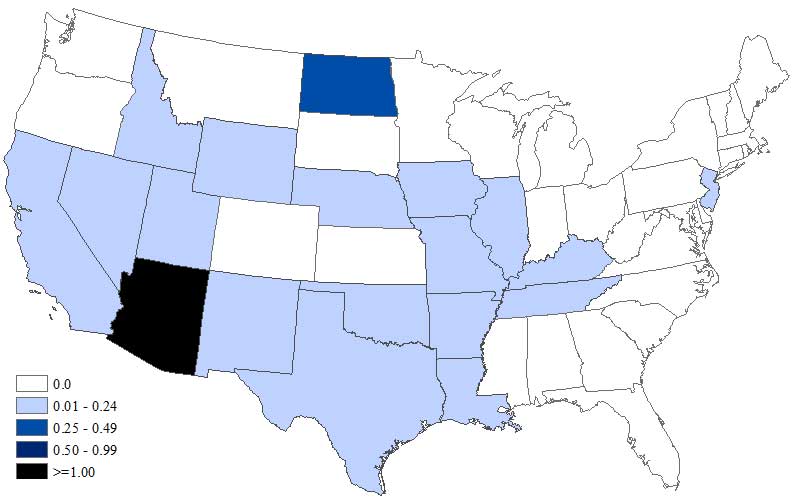
Skip directly to page options Skip directly to A-Z link West Nile Virus Neuroinvasive Disease Incidence by State 2019 West Nil...